
Why concrete slabs sink
Concrete can settle when soil below it changes, fill was not compacted evenly, water moves material away, or voids develop beneath the slab. Houston's long hot periods and heavy rain events can also make drainage and moisture management important parts of the conversation.
How slab lifting works
A provider identifies the low areas and selects injection points. Material is placed beneath the slab to fill voids and create lift. The process is gradual because the slab, adjoining concrete, steps, garage floors, pool coping, and other fixed elevations all limit how far a panel can safely move.
Concrete raising around homes
Common residential projects include driveway panels, front walks, sidewalks, steps, patios, pool decks, and slabs near garages. The goal is not only appearance; elevation changes can affect trip hazards and drainage too.
Questions to ask before hiring
Ask what material will be used, what elevation is realistic, whether void filling is included, how cracks and joints are handled, what drainage issues were noticed, and what warranty applies to re-settlement.
Polyjacking: how the foam lift works
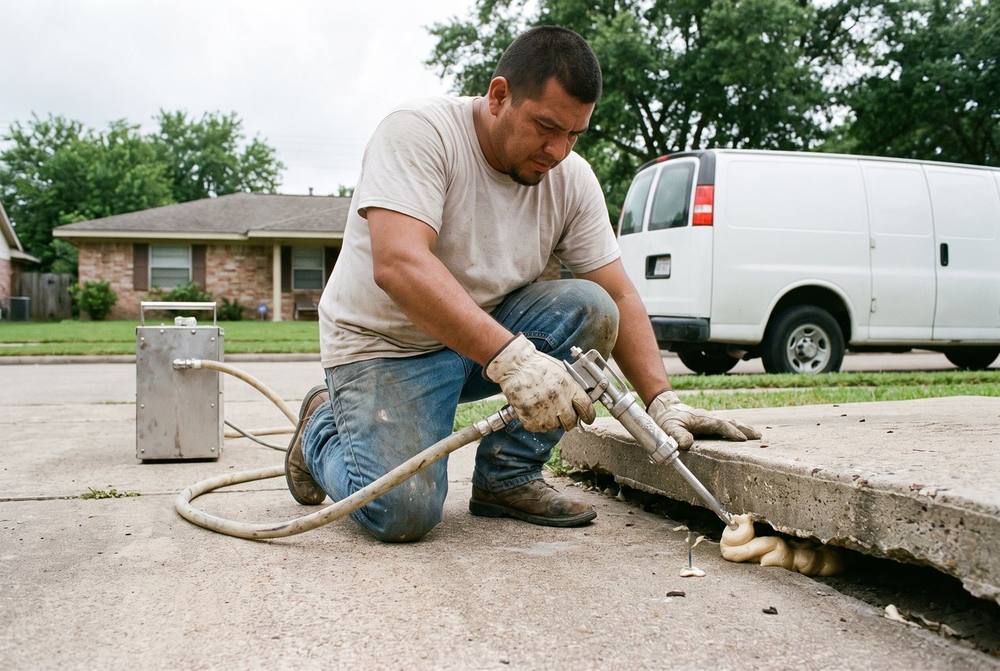
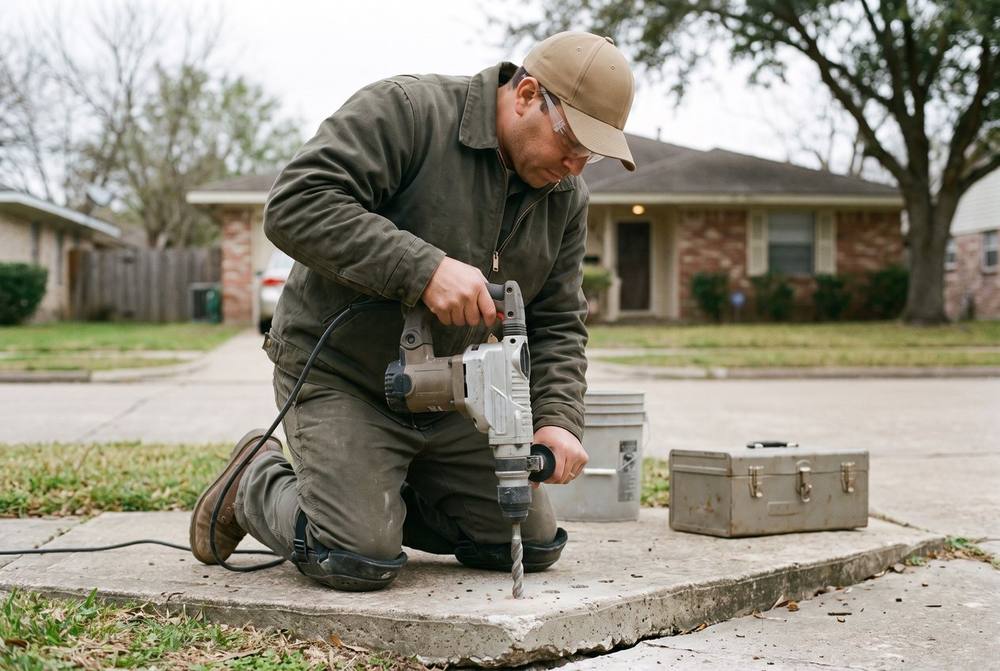
Polyjacking — also called foam jacking or foam concrete leveling — uses expanding polyurethane foam to raise settled slabs. The provider drills small holes through the concrete, usually about the size of a dime, and injects the foam beneath the slab. As the foam expands it fills voids, compacts loose soil, and generates lift. The provider works in stages, raising the slab gradually and checking elevation as they go.
Foam has a few practical advantages for residential work. It is lightweight, so it does not add significant load to the soft Houston soils that caused the settlement in the first place. It cures quickly, which means most surfaces are ready to use the same day. And because the holes are small, the repair is less visible than older methods — the patches are easy to miss on a driveway or patio.
Mudjacking: how the slurry lift works
Mudjacking is the older of the two methods. Instead of foam, the provider pumps a cement-based slurry — a mixture of soil, cement, and water — through larger holes to fill voids and lift the slab. It is a proven approach that has been used for decades, and it can handle heavy slabs and larger voids.
The tradeoffs are weight and footprint. The slurry is considerably heavier than polyurethane foam, which matters on the soft, moisture-sensitive soils common in Houston — added weight on already weak ground is not ideal. The injection holes are larger too, typically an inch or more, so they are more visible after patching. For many residential slabs, providers now reach for foam first and reserve mudjacking for situations where its density is an asset.
Lifting versus replacement
The decision between lifting and replacing usually comes down to the condition of the concrete itself. If the slab is largely intact — some cracking is normal — and the real problem is that the ground beneath it gave way, lifting addresses the actual cause. It is faster, less disruptive, and generally costs less than tearing out and repouring.
Replacement is the better call when the concrete is beyond saving: crumbled edges, extensive spalling, a slab that has broken into pieces too small to move as a unit, or a surface that needs to be re-graded so water drains properly. One honest consideration with replacement in Houston: the new slab sits on the same expansive clay that moved the old one, so the underlying soil behavior has not changed. A provider should give you a straight read on which category your slab falls into.
What to expect on the day of service
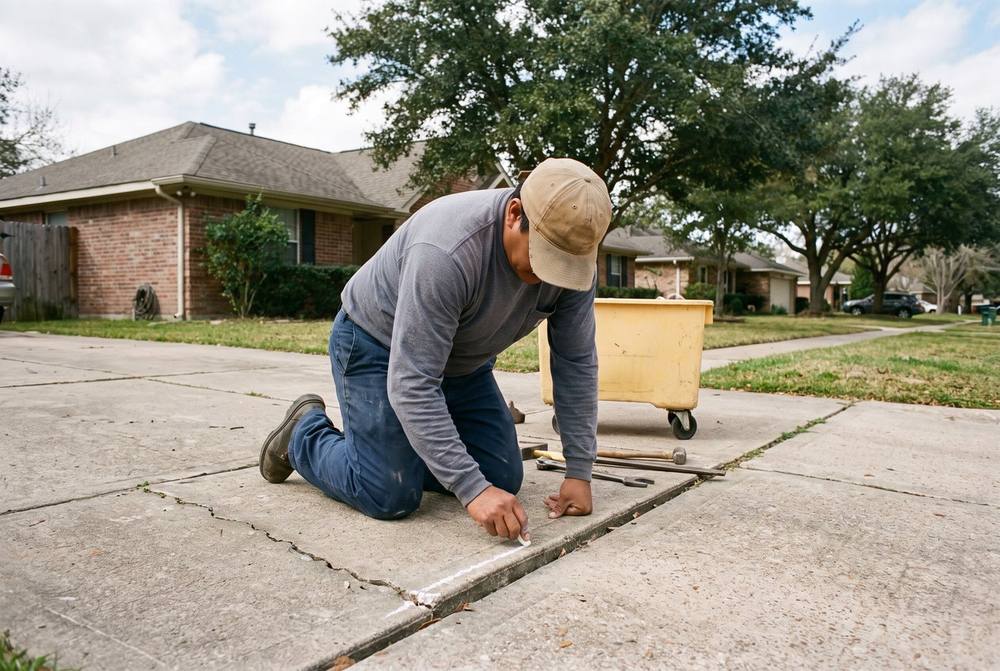
Most residential lifting jobs are completed in a few hours. The provider starts by marking the low areas and choosing injection points, keeping in mind how the slab meets fixed elevations like steps, garage floors, pool coping, and adjoining panels. Holes are drilled, material is injected in stages, and the slab is watched as it rises — the process is deliberately gradual so the panel does not overshoot or stress neighboring concrete.
Holes are patched when the lift is complete, and the crew checks the finished elevations and drainage before leaving. Because foam cures quickly, driveways and walkways are typically usable the same day. You do not need to move anything heavy off the slab beforehand beyond clearing the work area, and there is no heavy equipment tearing up the yard the way a replacement would.
How long a lift lasts
A well-executed lift can hold for many years. What determines longevity is mostly what happens to the ground afterward. If the original cause — a leaking irrigation line, a downspout discharging against the slab, poor drainage — is corrected, the slab has stable support and the repair lasts. Houston's wet-dry soil cycles continue regardless, so it is worth asking what the provider's warranty covers for re-settlement. Our guide on how long concrete leveling lasts covers this in more depth.
What lifting cannot fix
Lifting is not the answer for every slab. Concrete that is severely deteriorated, crumbled, or broken into small fragments will not move as a unit and should be replaced. Lifting also cannot fix a slab that was poured too thin for its load, correct a fundamentally bad grade on its own, or stop an active tree root from continuing to push. A reputable provider will say so during the evaluation rather than sell a lift that will not hold. That is also why the questions in the section above matter — they help you tell the difference between a provider diagnosing your slab and one selling a method.
Get a Houston-area quote
Call or send your ZIP code and a short description of the settled concrete. A provider can discuss the slab, surrounding surfaces and next steps during follow-up.
Explore concrete leveling and lifting in Houston, or request a free quote.
Free Quote Request
Tell us what settled. We’ll help you take the next step.
Related:
Concrete leveling cost
Polyjacking vs. mudjacking
Concrete leveling FAQ
Service areas:
Houston · Katy · Sugar Land · More areas